
The Tiny Screen That Refuses to Stay on the Fridge
VidaBay Snap launched as a battery-free e-ink photo magnet for the kitchen. A few months in, the most interesting thing about it isn't where people are putting it — it's why.
There is a very specific kind of clutter that lives on every refrigerator: a school photo curling at the corner, a postcard from a trip nobody quite remembers, a takeout menu nobody will ever call. The fridge door is humanity's oldest bulletin board, and it has not been meaningfully redesigned in about sixty years. VidaBay Snap is the first thing in a long time that has actually tried.
On the surface, it looks like a Polaroid that got stuck mid-development: a small, boxy print in a colored plastic border, magnetic on the back, sitting flush against a refrigerator door. Look closer and the “photo” is actually a four-color e-paper display, the same family of low-power screen technology used in e-readers. There's no glow, no backlight, no battery to charge. Once an image is loaded onto the panel, it simply stays there — through power outages, through years, through whatever you throw at it — until you decide to change it.
Changing it is the clever part. There are no buttons, no menus, no setup wizard. You pick a photo in the companion app, run it through a filter or a black-and-white treatment if you're feeling editorial, and then tap your phone against the magnet. The image transfers wirelessly in a couple of seconds, and the screen itself draws the small burst of power it needs from that exact transaction. No outlet. No cable. No subscription. It is, in the most literal sense, free of the device tethers everything else in your house seems to have.
It Was Never Going to Stay in the Kitchen
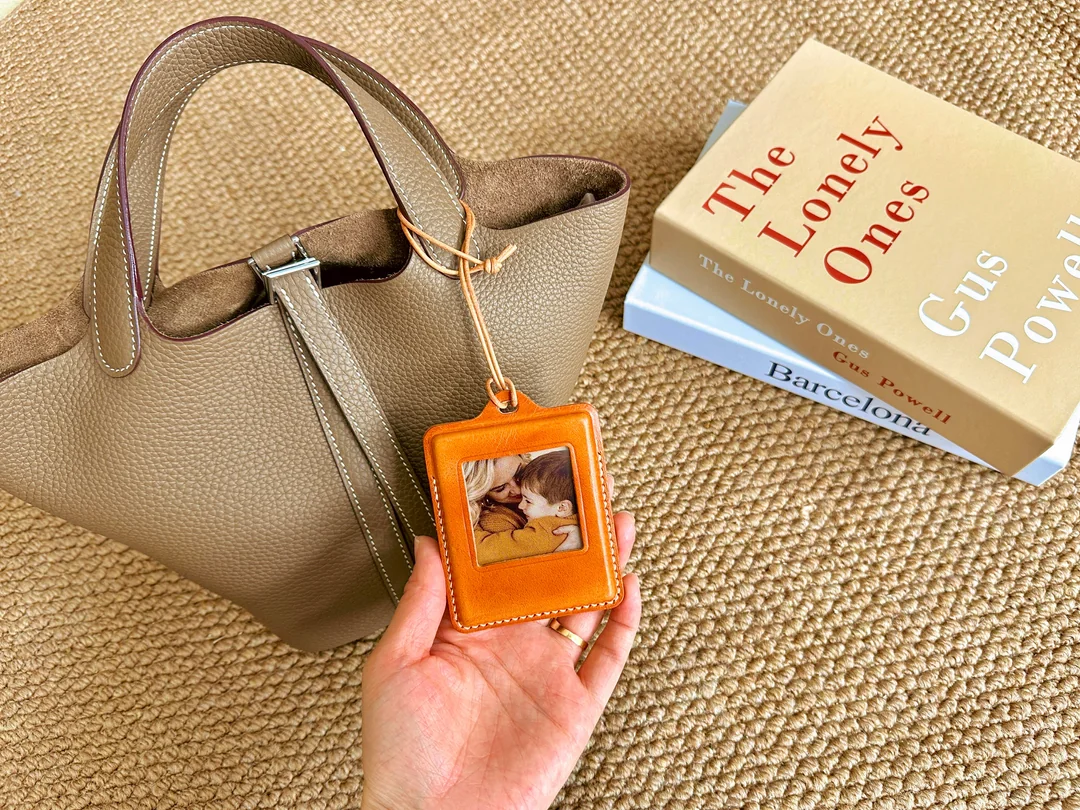
VidaBay built Snap as a home object, and most of its marketing still talks about whiteboards and reminder notes. But the company's own accessory line — a stitched leather sleeve, a small hanging pouch, a clip-style loop — gives away what was obvious the moment people got their hands on it: this thing was always going to leave the fridge.
Clipped onto a hanging pouch or threaded through a loop, Snap behaves less like a kitchen gadget and more like a piece of wearable, swappable jewelry for a backpack. That's a meaningful shift, particularly for a teenage audience that has spent the last decade decorating bags with pins, keychains, charms, and patches — every one of them permanent the moment it's attached. Snap is the first bag accessory in that category that updates. A pin says who you were when you bought it. Snap says who you are this week.
Swap in a concert photo before a show, a friend group selfie before a trip, a meme before a Monday — the underlying object never has to change, only the picture sitting inside it. Because the panel is e-paper rather than a backlit screen, it also reads less like a gadget clipped to a bag and more like a printed photo that happens to be reusable, which is exactly the aesthetic line teenagers tend to gravitate toward: analog-looking, but quietly smart.
A Gift That Keeps Working After You've Opened It
Most photo gifts have a shelf life of about one viewing. A printed mug, a framed 5x7, a photo blanket — lovely, and then permanently fixed to a single image from a single moment. Snap solves the problem nobody asked anyone to solve: what happens to a photo gift a year later, when the moment it captured has been replaced by a hundred new ones.
Because the display can be updated indefinitely, a single unit functions as a running gift rather than a one-time one. It works as a birthday present, a graduation token, a long-distance care package, or the small thing tucked into a holiday stocking that turns out to be more durable — emotionally and literally — than almost anything else in it. There's also a practical generosity to the multi-pack pricing: a three-unit set works out as a shared gift across a friend group or a family, with each person free to load their own image rather than receiving an identical copy.
Carrying a Person, Not Just a Picture
The quieter use case, and arguably the more important one, is what happens when the photo loaded onto Snap is of someone you can no longer just call up and see. A parent who's far away. A grandparent who's passed. An old friend whose group chat has gone quiet. A printed photo in a wallet does this job too, but it fades, creases, and eventually gets left behind in a drawer. A phone photo does it in theory, but a locked screen full of icons rarely feels like a place to keep someone.
Clipped to a bag or set on a desk, Snap turns into something closer to a locket than a gadget: small, quiet, and visible only when you choose to look at it. Because the screen holds its image without power, there's no risk of a dead battery erasing the one photo that mattered on the one day you reached for it. It just stays — patient, low-tech in spirit even if it isn't in practice — for as long as you want it to.
“A pin says who you were when you bought it. Snap says who you are this week.”
The Object Itself
None of this would matter if Snap weren't a genuinely well-made object, and on that front it largely delivers. The four-color e-paper panel renders photos with a soft, slightly muted clarity that reads more like a printed photograph than a screen — fitting, since avoiding the look and feel of a screen seems to be the entire point. The companion app handles filters, overlays, and black-and-white conversion before anything gets sent to the device, so the editing happens on your phone and the magnet itself stays refreshingly dumb in the best possible sense.
It comes in six border colors — black, white, yellow, green, red, and blue — priced individually or as a three-pack, with the leather sleeve and hanging pouch sold separately for anyone planning to wear it rather than stick it to steel. A single unit costs $29.99, with a three-pack at $86.99.
| Display | 4-color e-paper, photo-grade clarity, no backlight |
| Power | Battery-free; draws power from the transfer itself, image holds indefinitely |
| Editing | Companion app with filters, overlays, and black-and-white effects |
| Carry options | Magnetic back, plus optional leather sleeve and hanging pouch for bags |
| Colors | Black, white, yellow, green, red, blue |
| Price | $29.99 single unit / $86.99 three-pack |
The Bigger Idea
What makes Snap worth paying attention to isn't really the e-ink panel, clever as it is. It's the bet underneath it: that the photo objects we keep around us — on fridges, on desks, on the bags we carry every day — don't need to be disposable or permanent. They can be both reusable and personal, low-power and high-meaning, small enough to clip to a backpack strap and significant enough to hold the one face you'd want with you on a hard day.
VidaBay built a fridge magnet first. What it actually made is a small, quiet way of keeping people close, wherever you happen to be carrying them.
VidaBay Snap is available now at vidabay.net